Wondering what this meeting agenda will look like when you’re running your meeting? Take a look below!
Click here or above to try this template with your team.
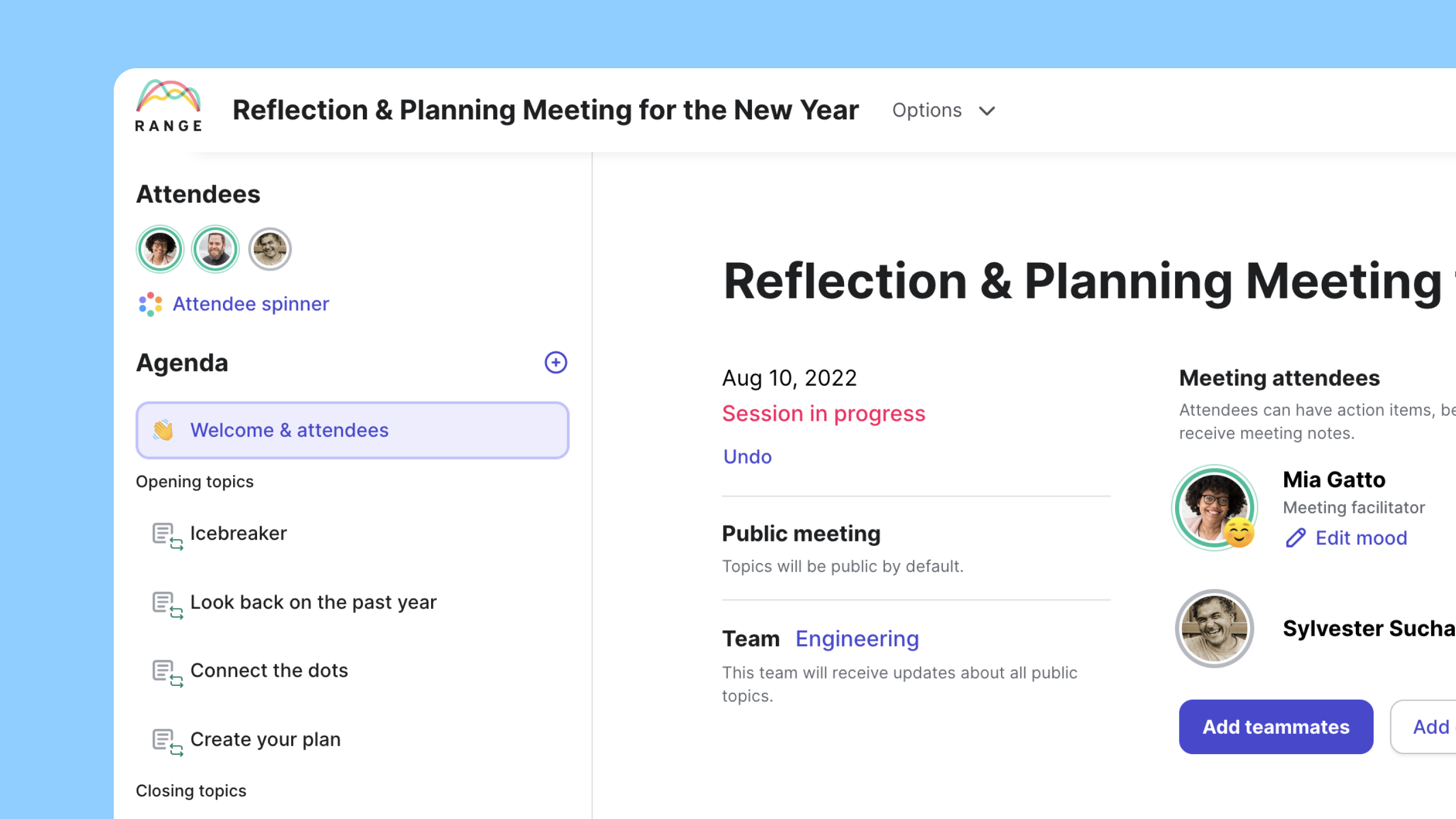
Join your team for a deep-dive into the past year, and use your reflections to inform plans for the year ahead.
Frustration and tension in planning often comes from a mismatch between expectations and the team’s ability to meet them. Consider the roles in the planning process: leaders are often focused on where the team is going, and team members are often focused on how to get there.
When teams and their leaders come together to reflect on the past year, the team’s unique insights can not only help them feel empowered about their own work but can also help guide conversations with leaders about what's possible in the year ahead. Check out the template below to learn about how you can structure a quick annual reflection and planning session with your team.
Tip: We'd recommend running an async reflection activity before the meeting to help team members identify some of their takeaways from the past year in advance. Prompts to distribute beforehand might include:
For more ideas beyond this list, check out our ebook of 150+ reflection questions for teams.
1. Icebreaker ( 5 mins )
Start by going around the room to give everyone a chance to share in a quick icebreaker question. Studies show that when teammates speak at the beginning of a meeting, they’re more likely to stay engaged throughout.
2. Look back on the past year ( 10 mins )
(Ideally as async pre-work before the meeting), use a collaborative whiteboard tool like FigJam to give everyone a chance to share their responses to predetermined prompts. Examples could include:
Then during the live meeting, give folks about 10 minutes to review everyone’s sticky notes.
3. Connect the dots ( 39 mins )
After you’ve gone through the “Looking back” exercise, take a step back and analyze what’s on your (virtual) whiteboard for themes and learnings. As a group, start by grouping related sticky notes together to help visualize themes and commonalities. Then, have your facilitator pose questions to kick off a discussion. Examples could include:
Be sure to take notes to capture your ideas!
4. Create your plan ( 30 mins )
Using your discussion notes as a reference, identify a short list of measurable actions that you can take to grow together as a team. Focusing on a few high-impact next steps makes it easier for the team to make progress towards the plan and ensures that whatever they commit to will likely be something everyone’s fired up about. Capture those next steps as action items.
5. Closing Round ( 5 mins )
Here are a few ideas:
Wondering what this meeting agenda will look like when you’re running your meeting? Take a look below!
Click here or above to try this template with your team.